Inertial Inflation and Correction of Control Effectiveness from Wind Tunnel Dynamic Excitations
Abstract
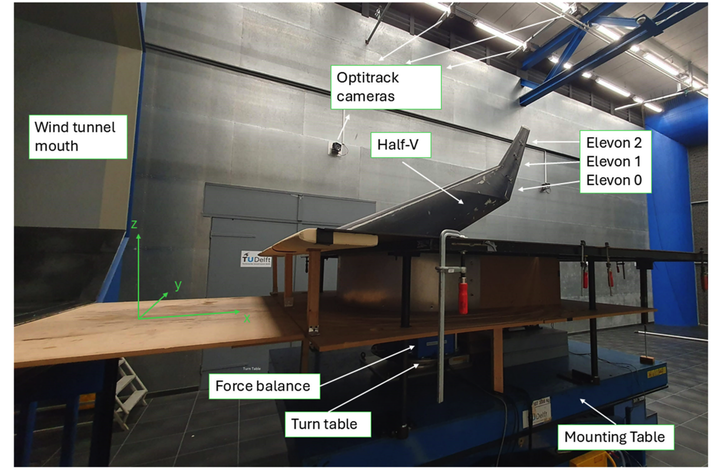
This paper investigates the identification of aircraft control surface effectiveness using dynamic multisine excitations in wind tunnel experiments. Experiments are conducted on a flying-wing configuration, and control effectiveness estimates obtained from dynamic excitations are compared with those derived from static control surface deflections. The study examines the influence of structural vibrations and inertial forces on the identified control effectiveness. In particular, dynamic excitation can produce an apparent increase in control effectiveness when excitation frequencies approach structural natural frequencies. This phenomenon, referred to as inertial inflation, highlights the importance of accounting for structural dynamics when identifying aerodynamic control effectiveness. The research addresses the implications of dynamic excitation methods for reliable control effectiveness estimation in flexible aircraft.